

Kinnari’s Dialogue
I was lying in bed, a bit sick, when I got a text from a close friend - “You seemed very confident yesterday in your decision making. What’s going on today?”
I texted back - “Not great. I’ve been doubting it and can feel myself tearing up.”
I have spent the last two weeks circling a difficult decision. Should I pick option A or option B? Every day, a long conversation with a different close friend and my new AI buddies, Gemini, ChatGPT, and Claude. There’s only so much spinning a person can ask their dearest friends to absorb before the fatigue sets in - and the GPTs, to their credit, never tire of the same question asked seventeen different ways.

And through all of it - the conversations with my husband and friends, the AIs, the therapist, the pros-and-cons lists - I had completely forgotten the thing I’d been studying for months - the core of Yoga Sutras 2 and 3. The Yoga Sutras of Patanjali are a collection of ~196 aphorisms, or “threads,” written around 400 C.E. that serve as the foundational text for classical yoga philosophy. They provide a roadmap for controlling the mind to achieve enlightenment and self-realization, focusing more on psychology and meditation than physical postures.
Yogas citta vrtti nirodhah (Sutra 1.2)
Yoga is the restraint of the modifications of the mind.
The reason we must practice Yoga is to stop the fluctuations of the mind. If we can still our mind, we can control everything. The “spin” I was in is exactly what Patanjali calls vṛtti. If we can control the mind, we can navigate anything. But why do we want that stillness?
tadA drashTu swarUpeYvasthAnam (Sutra 1.3)
Then you see yourself as what you truly are
By making our minds still, we can observe our thoughts from a bit of distance. A few months ago, I wrote in my journal about watching the thoughts swirl in my head from a distance -
“There have been days where I’ve watched the swirl in my head from a little bit of distance. I’ve seen how the thoughts in my mind shift like a pendulum from the morning to evening, or perhaps within the hour. If I don’t get emotionally attached, I am able to be amused by it all.”
But these past two weeks have been a completely different story. Instead of observing my thoughts from a distance, I dove right into the swirl and got caught in it. There was no observing - just diving headlong into the riptide of my thoughts, being pulled one way and then another.
In the Yoga Sutras, after stating that the purpose of yoga is to still the mind, Patanjali explains how to get there. In Sutra 1.12, we learn that the mental modifications of the mind can be restrained by practice and non-attachment. Of these two, effort toward steadiness of mind is practice (Sutra 1.13).
It means we must become watchful, observe every thought, word and action. The way to do this is with the following three qualifications.
Yoga Sutra 1.14: “Practice becomes firmly grounded when well attended to for a long time, without break and in all earnestness.”
The first qualification for the practice is that it should be done for a long time. There is wisdom in Patanjali not telling us exactly how long. We must keep at it without asking, without wondering when we will achieve our goal. The practice is the journey. There is beauty in the repetition. These days, while working with my Yoga teacher, when she’s telling me to “bend forward, hands on the floor” for the twentieth time while doing our surya namaskars - I’m working hard on restraining myself from asking “How many more times!?” and instead tuning in to my body - the aches, pains, and even the resistance.
And then it should be without break. I have been sitting in meditation on and off for many years but always with long breaks in between. Same thing with publishing posts here on Disco Dialogues. The practice must be consistent without breaks.
And the last qualification is “in all earnestness.” I must pay full attention and apply my mind to it. Change is happening and I must have faith.
What I love about Sutra 1.14 is that it gives us the three most foundational aspects for any practice we undertake. Whether you are hitting the gym, learning a new language, or committing to a meditation practice, the requirements are the same: Patience, Devotion, and Faith.
Last week reminded me that I’m still a beginner. My practice wasn’t “firmly grounded” enough yet to keep me out of the riptide. The beauty of the Sutras is that they are always there to meet you when you crawl back to shore.
A few days later, I texted my friend back. “Better,” I wrote. “I think I know what I’m doing.” I’m not sure that was entirely true, but the Sutras don’t ask for certainty - just that you show up and practice again.

Mitali’s Dialogue
Last March I completed a five day hiking trip in Chile covering around fifty miles through glaciers and granite peaks. On day three, one of our toughest days, we walked for almost eleven hours. Half way through the trek after having just completed a four mile round trip to a glacier lookout point with an elevation gain of 700 ft and back down, my feet were starting to blister. Knowing that we still had another five to six hours of walking still left, I started to despair on how I would complete the trek.
I was dealing with aching feet, blustery wind in my face and a heavy backpack on my back. I noticed my confidence starting to slip. The destination seemed unattainable - Refugio Paine Grande, our hostel for the night was at least five miles away. I experienced a flood of emotions - overwhelmed from the miles left ahead of me, fear that I was attempting something too hard for my body, and frustration from the blisters on my feet. Thoughts followed the emotions telling me that the path ahead was difficult.
But moving forward was the only option available to me. Trying to get a grip on my emotions, I put my head down, looked at the ground and started repeating to myself - “one foot in front of another, Mitali.” I wasn’t going to distract myself by looking ahead at the majestic views around me. The pain in my legs became secondary to the task at hand - the steady placement of my feet on the boulders in my path. It wasn’t easy and there were moments when my group of female companions looked at each other wondering why we had signed up for this experience. But the mantra I had started in my head carried me through those last few miles.
When we finally reached our hostel in the late evening and dumped our backpacks, I reflected on my accomplishment from the day. I had just put my body through a physical endurance test and could have succumbed to the emotions swirling in my head. What had gotten me through the day was the simple act of taking one step at a time. I had managed to detach myself from the thoughts that weren’t helpful. Directing my attention to my feet and the poles in my hand, I was able to take the action that was needed in the moment.
Yoga Sutra 1.15: The consciousness of self-mastery in one who is free from craving from objects seen or heard about is non-attachment.
Since then I have found myself coming back to that mantra when a task seems daunting. Instead of letting my emotions run amok, by thinking about whether I will feel good for having done it or bad for having not done it, I tell myself that this just needs to be done. When I still struggle to get started, I break the task down into its simplest step that is non-negotiable. A step that is so easy to do that I can’t be distracted by other desires. Sometimes that is - Sit on the meditation cushion. Or open the spreadsheet. Or commit to meeting one person. This is how I manage to convince myself to start.
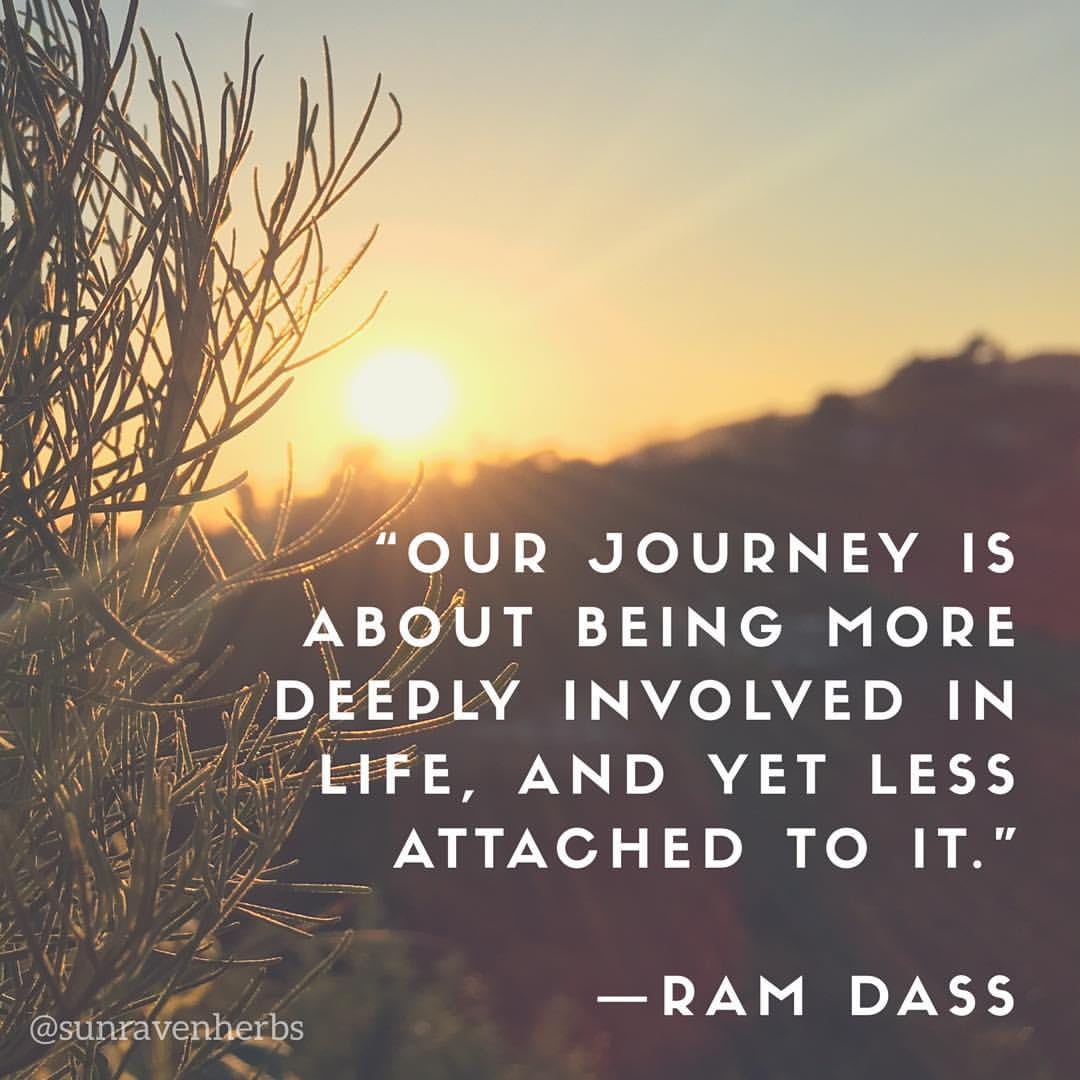
In the Yoga Sutras, vairagya (non-attachment) is the detachment from the results of our actions. When the mind starts to swirl, non-attachment is one way to bring the stillness back to our mind. The moment my mind thinks there is a choice to be made, it can start to create vrittis - churning up thoughts, emotions and desires driven by the external world. Instead I can stump my mind by taking away the choice. The desire for a reward or the fear of punishment falls away. There is no counter argument to an action that must be taken. Without a focus on the results of the action, there is only the action.
This is a lovely start to my day today. As the school break has shifted all my routines, coming back to the practice I love (writing) and perhaps even coming back to yoga would be a really good return.