
Mitali’s Dialogue
I recently read an article by an HBS professor Leslie John where she talked about the power of oversharing and how most people tend to share “too little information” (TLI) about themselves vs “too much information” (TMI). I was reminded of my days as an HR leader where I found it challenging to convince senior leaders to share more about themselves and their feelings with their team. It is hard to be vulnerable as a leader as many view it as a weakness to expose themselves to others’ judgement.
Recently, in a conversation with an executive stepping into a new role, this concept of “oversharing” came up. We were talking about how AI is disrupting old industries. As she was going through the interview process, she expressed some hesitation around talking openly with the board and her peers about the uncertainty ahead due to AI. Her observation was that leaders tend to share less openly in uncertain environments in order to appear like they have control. But in reality no one knows how things are going to play out with AI. Despite this, she struggled with sharing her doubts and fears about the future, to avoid being perceived as an incompetent leader.
From my own experience in the corporate world, both as a leader and as a coach working with executives through transition, I know the opposite to be actually true. To be considered a highly regarded leader, it is important to be vulnerable and show humility when you don’t know what lies ahead. Navigating through a disruption when the future seems hazy is often the toughest job and yet also the hallmark of an excellent leader. In this new era of AI, asking the right questions from a place of not knowing can lead to more creative discussions.
I know from personal experience how tough it is to be in this situation. I knowingly chose to disrupt myself nine years ago. After a long career on the business and product side, I decided to take on a senior role in HR at Google. I went from being at the top of my game to suddenly being the novice in the room. There was a lot of skepticism from the team that I inherited about my ability to lead them through a significant change that was happening in the business. I also felt a slight disregard from my clients who were not sure how to evaluate me as their HR business partner given my lack of experience in the field.
I found myself in a tricky situation. In order to deliver results to my clients, I was dependent on my team who had deep HR expertise. But in order for them to deliver innovative solutions, I also needed them to break away from their old patterns of thinking. So I chose the path of transparency. I admitted to my senior managers that I sometimes didn’t know what I was doing because I did not have their years of HR experience in the job. I stopped being afraid of asking dumb questions and instead relied on my business and partnerships perspective to help them look at problems through a different lens. I shared confidential information from senior client meetings openly with them. Trusting them with more information and exposing my vulnerabilities led to a higher performing HR team that became known for its innovative approaches to business challenges.
On the personal front however, I am a bit more guarded. I tend to be more reserved with my emotions and reluctant to share my personal struggles openly. I much prefer being the questioner in conversations rather than being in the spotlight. This often leads to me revealing less about myself which can make me come across as distant sometimes.
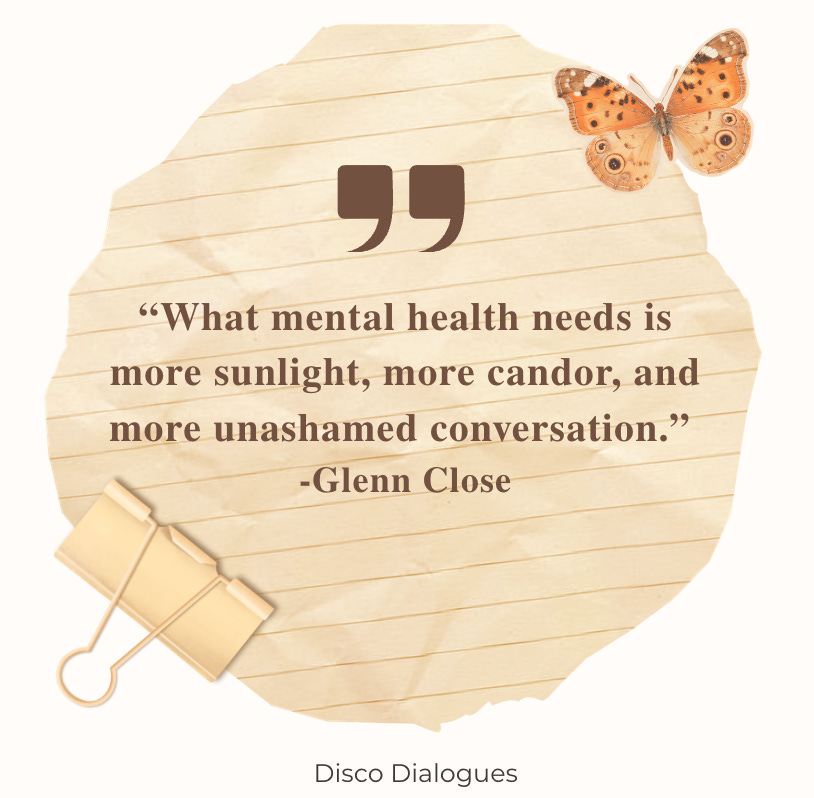
So for the past five years, I have used this Disco Dialogues platform as an experiment for me to open up about myself. Four years ago in May, as part of Mental Awareness Month, I published a post on my struggles with my mental health. The post felt risky at the time as I had not widely shared my personal experience beyond close family and friends. I had not brought this up at work as there was a certain stigma around leaders talking openly about their mental well-being. But I found that the more I shared with our community of readers, the more comfortable I became in exposing different facets of myself. I ended up posting that essay on LinkedIn and it got shared widely beyond my network. People connected with my words because I had chosen to “overshare”.
Over the years, my writings on Disco Dialogues have widened the aperture with which people view me. People who have known me for years as a techie or a business leader or a working mom have now learnt about my challenges of being a mom to a special needs kid, or the joy I get from being in community with live performers or the patience I have built through my study of spiritual scriptures. The past five years have been a journey of revealing more about myself to a wider audience on Substack and seeing how it opens up doors for new conversations to get started. And embracing the freedom it brings.

Kinnari’s Dialogue
A couple years ago after coming back from maternity leave my work load wasn’t full yet and I was trying to figure out how to have more impact. I saw an email about doing a facilitation course and signed up. Over the course of my career I’d led several programs and sessions where I’d ended up creating safe spaces for people to open up and share. This seemed like a good opportunity to get some formal training before becoming a certified facilitator for teams across Google.
It has always been easy for me to open up and share stories in new situations with people I’ve just met or known casually. I have a self-deprecating humor that has contributed towards making strangers feel at ease and open up in my presence. But sharing my faux pas while standing in front of a room where I’m about to facilitate a session is different.
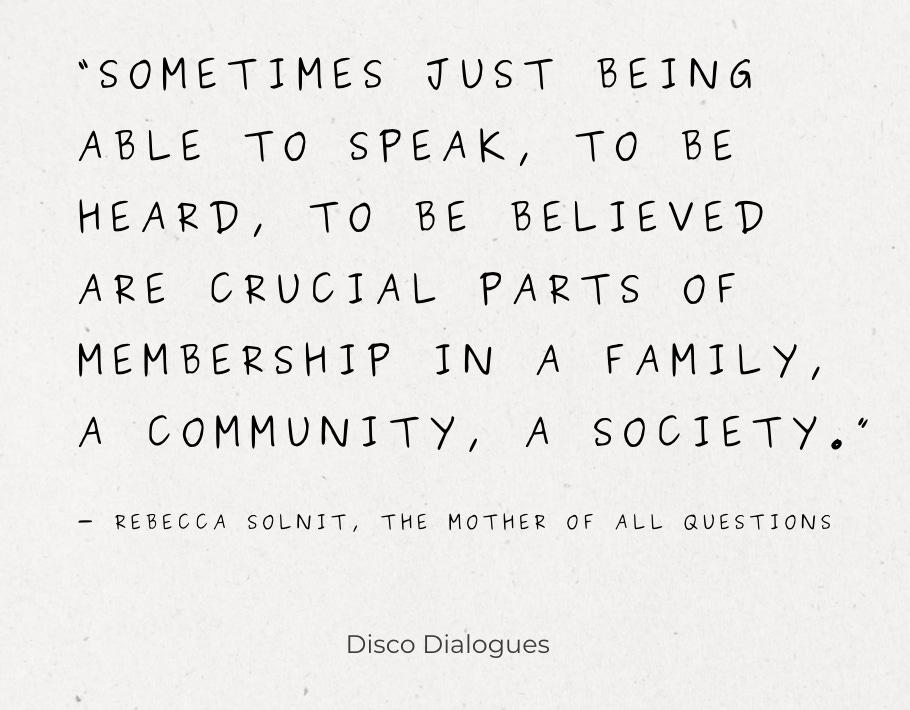
“Words bring us together, and silence separates us, leaves us bereft of the help or solidarity or just communion that speech can solicit or elicit.”
- Rebecca Solnit, The Mother of All Questions
I was leading a session on growth mindset with about 40 people in the room and we were about to discuss impostor syndrome. I wanted to share a personal story to set the stage when a thought crossed my mind - “Don’t they need to think I’ve got my shit together?” I let it pass and shared - “So the first two weeks of being here at Google I kept thinking someone had made a mistake. They were going to call me and say nope - not you. You didn’t go to an Ivy League school so you don’t belong here. It took me years of delivering work of the same caliber as my colleagues before I finally believed that I belonged.”
I’d shared this story with friends before but never in a professional setting with other Googlers. It came out before I’d decided on the best way to share it. That’s who I am. Someone that doesn’t give much thought in the moment to how I might be perceived. The “work me” is the same as the one at home, and the one out in the world. I share myself authentically, no matter which room I’m in. So even when it’s at the head of the room, I feel quite comfortable opening up.
“Give me the courage to show up and let myself be seen.” - Brene Brown
It’s not because authenticity is a core value (it is) but because I have learned the power of sharing vulnerably. I have found that when I share a personal story or something I’m struggling with, it’s an invitation to everyone in the room to open up. It is me expressing I’m not perfect, so what? It helps break the ice and lets us connect as humans. As soon as I shared my experience about feeling like an impostor, it opened the door for others in the room. One person spoke about how unqualified they felt stepping into a leadership role for the first time. Another spoke about how they felt like they were faking being good at parenting.
I was connecting with people by being vulnerable years before reading Brene Brown’s explanation of why vulnerability was important. I didn’t have the words but knew experientially - that sharing openly led people to do the same.
I still don’t think too much before I share. I’ve just stopped questioning if it’s a problem. Of course there are moments of “yikes, maybe I should have waited to share that” or “I should have said that differently”. But then the person on the other end gives me a genuine smile or shares a story, opening up a dialogue between us and it makes it worth it. And if that doesn’t happen, I just remind myself: it doesn’t have to work every.single.time.
Oh and in the spirit of oversharing, we are excited to share that we hit 100 posts in April! That’s about 120,000 words written collectively over four and a half years which would make for an engrossing 400 page book. 😀