Kinnari’s Dialogue
If this season of your life was a chapter in a book, what would the title be?
This past week, while hosting a moms’ night, I posed that exact question to the room. I had started hosting these monthly moms’ hangouts earlier this year with the purpose of building community in our neighborhood around our kids. The first few sessions were free flowing and conversations happened organically in small groups. This time I wanted to experiment with a structured format and see where it would take us.
What followed was an unexpectedly intimate conversation breaking away from polite chit chat about our kids. Amongst a group of relatively new acquaintances, we uncovered our inner struggles and also discovered the commonality between us.
One mom who had quit her job a few years ago and is raising teenage boys while also helping with her partner’s startup said this chapter for her would be titled “Confusion“ - unsure of what the next step in her professional or personal life should be.
Another said her chapter would be “Plateau“ because in some ways she had achieved most of the goals she had set out for herself - a career, marriage and a kid and was now unsure of what the second mountain should be.
A third shared that hers would be “Contentment” - a state of feeling she derives from her young kids who enjoy her presence and having parents that are relatively healthy.
Then came “Guilt” from a mom who had chosen to leave corporate and was taking the time to focus on herself. Her guilt was about having the privilege to be able to do this when so many others around her couldn’t.
Another shared her “Sadness” from wanting to resume work after her second child was born but how she found herself pushing out that timeline to meet the needs of her kids.
On a walk the next day a friend said hers would be “Finding myself” while she was busy raising two kids under 5.
When I asked one of my closest friends who’s stepped down from running her own company, she said “Transition”.
“Our society confuses them constantly, leading us to imagine that transition is just another word for change. But it isn’t. Change is your move to a new city or your shift to a new job. It is the birth of your new baby or the death of your father.
...In other words, change is situational. Transition, on the other hand, is psychological. It is not those events, but rather the inner reorientation and self-redefinition that you have to go through in order to incorporate any of those changes into your life. Without a transition, a change is just a rearrangement of the furniture. Unless transition happens, the change won’t work, because it doesn’t “take.”
Whatever word we use, our society talks a lot about change; but it seldom deals with transition. Unfortunately for us, it is the transition that blind-sides us and is often the source of our troubles.”
- William Bridges, Transitions: Making Sense of Life’s Changes
I see myself being reflected in each of these women’s stories. Despite the disparity in our ages, and the differences in our upbringing and cultures, the thoughts in our heads were similar. Is it the life phase that we are in - all moms to young kids? Or is it our environment - the ambient pressure of Silicon Valley which demands ambition of you? Or are we all at any given time going through some change or the other and figuring out how we transition with grace?
Mitali’s Dialogue
I have recently been thinking about the different people that I have integrated into my life - the relationships I have intentionally chosen. “Relationship” often connotes a romantic connection with a partner but I am using the term broadly to define the human connections we purposely forge with others beyond our family and the blood connections.
It started with an award I received this month from my alma mater for starting a Founder community. Five years ago I sensed a need within our alumni and created a peer‑learning and leadership program tailored to alumni entrepreneurs. I designed the program as a trusted, structured space where founders could share challenges and support one another, especially post COVID‑19. It has brought me a lot of joy in bringing strangers together to invest in a peer support group where they can share honestly and vulnerably about what is often a very lonely journey as a founder.
We each opt to invest in different relationships at different phases in our life - friendships that are formed during the four years of college, a committed partnership with a loved one, a parent community where we bond over the shared experiences of our kids going to school together, a peer support group formed through the common experience of being a founder. No one forces us into these relationships. We willingly put our limited time and effort into creating and deepening these bonds.
As I reflected on my own experience being part of multiple groups and relationships, I realized how much of a commitment I have made to each of them. Here are some words of wisdom that serve as reminders to me on why I continue to invest in these human connections. Each meaningful interaction provides a new perspective that helps me navigate the uncertainties in life.
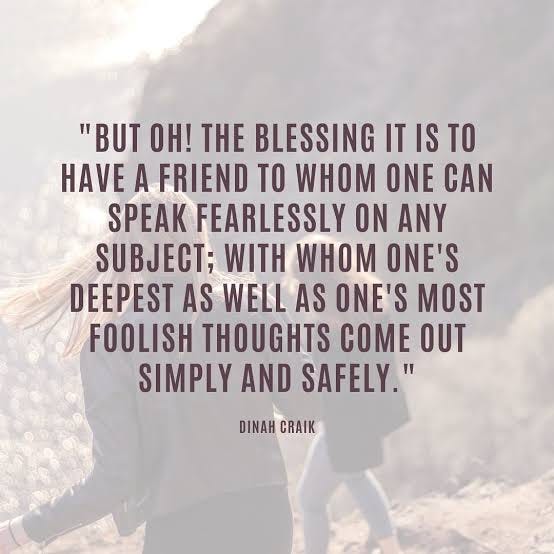
A friend shared a podcast episode by Mel Robbins on female friendships and it struck a chord with me. As we get older and get subsumed by the never-ending responsibilities at work and at home, the proximity relationships with partners, kids, family members and work colleagues often take precedence in our lives. But it is often our close friends that we rely on when times get tough, who know us deeply and can support us through those difficult times. Investing in these friendships takes time that often many of us don’t have, especially when they are not in a 25 mile radius.
It’s Not You: The Real Reason Adult Friendship Is So Hard & 3 Ways to Make It Easier
Here are some nuggets of wisdom from this episode -
Female friendships center around “symmetry” - equal sharing of information, “support” - being there for each other, and “secrecy” - maintaining confidentiality about what is shared in that friendship.
Female friendships tend to form through “dyad” relationships (a set of two treated as one) while male friendships tend to form around “packs”. I have naturally gravitated towards 1:1 conversations with friends and found this to be an interesting anthropological insight.
Women tend to long for a “bestie” but we don’t have to rely on one friend being that person for us - it is often better to have a “collective” to depend on. I found it freeing when I started to rely on different friends for different situations and perspectives, like parenting or career or spiritual advice.
I was recently in a discussion with a friend about the complexities of the relationship with their in-laws and their partner. We ended up talking about the purpose of these people in our lives. This article - Your Closest Relationships Are Your Greatest Karma - provides a perspective that may help when dealing with difficult situations with people in your life.
“...This is what the evolution of consciousness actually looks like. Not a dramatic transformation that happens all at once. But the slow, steady realisation arrived at through the very relationships and circumstances that challenged us most, that we are far less limited than we thought. That the patterns we believed were permanent were workable. That the fears we thought defined us were not the self.”
- Harshna Chandolia, author, vedic astrologer
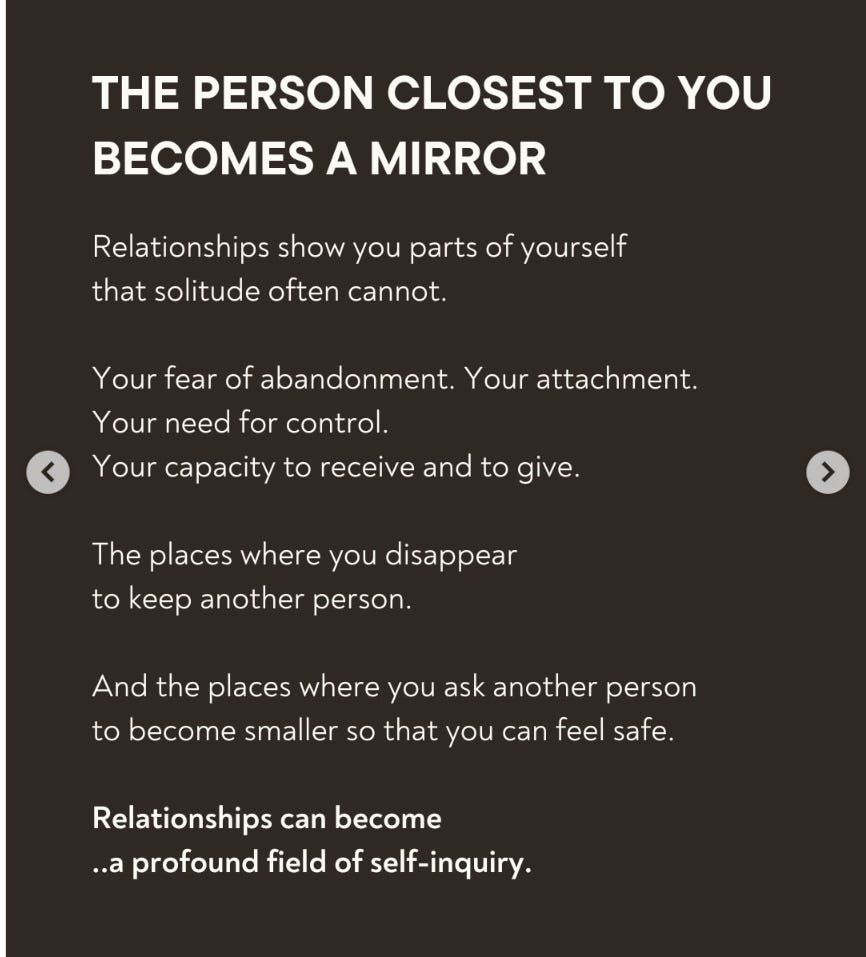
A discussion on relationships would not be complete without talking about the most important relationship that we choose to enter into - the one with a loved one. The road of any relationship with a partner is bumpy with its share of ups and downs. I found this reflection to be helpful in giving me perspective during the difficult times - I get to discover more about myself by looking at the relationship as a mirror.