

Kinnari’s Dialogue
I have been thinking a lot about how we communicate and the impact our words have on others. As an emotional being, I tend to be reactive in the moment which doesn’t lend well to communicating with patience especially when things get heated.
A couple months ago I was upset with a close friend and wanted to reach out to her and express how I felt. However, I recognized that I was in the middle of an internal spin and needed to pause. That’s when I picked up The Art of Communicating by Thich Nhat Hanh from my bookshelf (had purchased it several years ago to improve my communication with my husband). The simplicity of his words landed powerfully.
“In a relationship we are nourishment for each other. So we have to select the kind of food we offer the other person, the kind that can help the relationship thrive. If suffering continues, it’s because we keep feeding our suffering. Every time we speak without mindful awareness we are feeding our suffering. Every thought you produce feeds your relationship. When you produce a thought that carries suspicion, anger, fear, irritation, that thought is not nourishing to you or to the other person. If the relationship has become difficult, it’s because we’ve nourished our judgement and our anger and we haven’t nourished our compassion. In just an hour you can transform another person and yourself, just with the practice of watering the good seeds.”
I started reading the book to find ways to communicate with compassion with a friend. However, Thich Nhat Hanh says that in order to communicate well with others we must first learn how to communicate with ourselves. “If you don’t communicate well with yourself, you cannot communicate well with another person. Come back again and again and communicate lovingly with yourself. Listen to the happiness you may have in this moment. listen to the suffering. learn how to embrace it and bring relief.”
That shifted things for me. I’d picked up the book to figure out how to have a conversation with someone else, and instead I found myself needing to have a better conversation with myself first. “Self-understanding is crucial for understanding another person; self-love is crucial for loving others.” I decided not to reach out to her and instead took some time to sit and understand myself, understand why I was feeling hurt.
Here are the highlights that stayed with me, in his words:
1) Connecting internally - to stop and communicate with yourself is a revolutionary act. Just sit down and breathe in and out. In a few seconds you can connect with yourself. You know what is going on in your body, your feelings, your emotions and your perceptions.
2) The power of writing - If you can write a letter or email that’s full of understanding and compassion then during the time of writing you will nourish yourself. At the beginning of your practice it may be easier for you to practice mindful communication in writing. If our message is full of understanding and compassion, we’ll be able to remove fear and anger from the other person.
3) Coming Home - Mindful awareness is the path home to ourselves. Home is the place where loneliness disappears. Home is inside us. It requires only sitting down and being with yourself. Accepting the situation as it is. With our in breath and out breath, with our mindful breathing we begin to tidy up our home.
4) Communicating with the breath - the path home begins with your breath. Mindful breathing is a means of communication between the mind and body.
Breathing in, I know I’m breathing in.
Breathing out, I know I’m breathing out.
Breathing in and breathing out is a practice of freedom.
Focusing our attention on our breath we release everything else, including worries or fears about the future, regrets or sorrows about the past. We can be there for ourselves.
5) Nonhinking and Nontalking - to communicate with ourselves, we need to practice non thinking and non talking. A lot of our thinking is caught up in dwelling on the past, trying to control the future, generating misperceptions and worrying about what others are thinking. When we stop talking and thinking we listen mindfully to ourselves, one thing we will notice is our greater capacity and opportunities for joy. The other thing that happens when we begin listening to ourselves is that we notice the suffering present in our lives, there may be pain and tension in our bodies, old pain and fears, or new pain and fears we have hidden under our talking and texting and thinking. Mindfulness lets us listen to the pain, the sorrow and the fear inside. We don’t run away from it.
In the middle of that spin, I took the time to sit and go inwards leveraging my breath as a tool. I allowed myself to feel sad, to let the tears flow without trying to resolve it. I held back from reaching out to express myself and dropped the expectation that the other person had to fix it, to make a change, to provide me with validation to help me feel better. I was there for myself and was surprised to find that in a few days the hurt melted away. Gone was the need to reach out. I was able to look at what had happened with more objectivity and see how a lot of the hurt I felt had been created by my own mind.
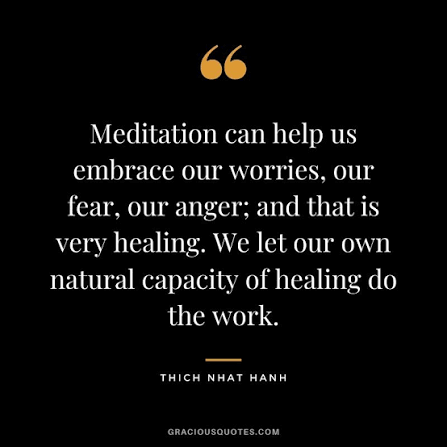
I hope Thich Nhat Hanh’s words make you take a pause and reflect on how you talk to yourself. It has certainly done that for me. I have been taking time to understand myself (my emotions, thoughts, feelings) first before reaching out to understand and communicate with another. This has helped me address any conflict or hurt feelings with a lot more peace and kindness.