

Mitali’s Dialogue
Am I too comfortable with my life? Have I lost the ability to do hard things? Am I challenging myself? It’s crazy how quickly these self-doubts pop into my head. Over the past six years since I stepped away from a corporate career I have found myself stuck with these questions multiple times.
I chose to embark on this journey of forging a new path for myself once I left Google. Over the years I have grown comfortable with not being defined by my work - a title or a company. It hasn’t always been smooth and a lot of my writings here have been about that journey. Yet each time these thoughts rear their head, I am caught off guard. Have I not already worked through this self doubt? Why is this the loudest voice in my head?
Self doubt and fear used to not have a prominent place in my life. I learnt to exercise courage early in life thanks to my parents. They chose to move countries multiple times in my first twelve years of childhood, placing me in situations where I had to adapt to new environments and build resilience. I moved from Oman to the US at the age of eighteen, landing in a new country, starting college in a place I had never visited before, not knowing a soul on campus. But I soon figured out that I was not afraid of the unknown. I quickly learned how to thrive and make friends and adapt to a different educational system and way of living.

When I entered the workplace, I gravitated to new risky opportunities. I would raise my hand every couple of years to move to a new office or start out fresh in a new role, enjoying the experience of being a beginner again. “Thriving in ambiguous situations” became the hallmark of my professional career. Choices were finite so I exercised courage constantly and like any muscle, repeated use continued to strengthen it.
But once I left the corporate world after twenty years, it became harder to keep this muscle strong. I had to find new ways to challenge myself. Like any muscle, courage has a tendency to atrophy when not in regular use. Without work as the container, I would often find myself frozen when faced by novel opportunities - struggling with the many choices ahead of me and finding nothing compelling enough.
In 1844, Soren Kierkegaard, a Danish philosopher who is considered the father of existentialism, wrote of anxiety as being the ‘dizziness of freedom’ - a philosophical concept describing the overwhelming, vertigo-like feeling when one realizes that one has the absolute freedom to choose. When the future is open, we start to dread the infinite possibilities and the weight of choosing and being responsible for the outcomes of our choices leads to anxiety.
So in January when a new opportunity came my way, I found myself stuck again. Is this the best use of my time? Am I using my privilege for good causes? Will this opportunity help me have the most impact? Fear of making the wrong choice led to procrastination. Procrastination resulted in inaction. Continued inaction started to erode my self-confidence. I started to question if I was even capable of doing hard things anymore. The lack of clarity in direction became an excuse to sit on the sidelines waiting for the motivation to show up. And slowly doubts turned into anxiety. Did I even have the energy to take on this endeavour? With these questions swirling in my head, it became easier to just not commit to anything.
“He who, restraining the organs-of-action, sits thinking in his mind of the sense-objects, he, of deluded understanding, is called a hypocrite.
But, whosever, controlling the senses by the mind, O Arjuna, engages his organs-of-action in KARMA YOGA, without attachment, he excels.”
- The Bhagavad Gita, Chapter 3, verses 6-7
This month I found an inner desire to start reading the Gita. As I delved into the initial chapters, I found solace in the ancient wisdom captured in the book. Self-doubt is natural - even the great warriors faced it thousands of years ago. The Gita showed me that clarity doesn’t emerge from sitting still and waiting. It emerges when I take a step in one direction without focusing on the results. Inaction is not an option. As humans, we are meant to act. If we don’t engage in physical activity then the energy gets stuck in our mind and leads to a repeated thought pattern. What you do when you are overcome with doubt is what matters.
For me the hardest thing to do when I have lost self-confidence is to take that first step. It requires trust in the Universe to be comfortable with uncertainty about the future. It takes patience to believe in the process. I tried to make it as easy as possible to move into action by pushing myself to take small actions that felt uncomfortable but tolerable - volunteering in the community, reaching out to a stranger for a conversation. These actions gave me the courage to start engaging in more physically stressful activities like cold dips or strenuous hikes. Each act of doing something got me out of my head, away from the thoughts that were consuming my mental space. The more I practiced these “hard” things, the better I got at strengthening this muscle again.
And slowly I began to realize that courage has always been within me. I just needed to believe in it again.
Kinnari’s Dialogue
It was 5 pm on a Tuesday, and instead of rushing home to take over from the nanny, I was in a class with nineteen other adults learning about the first rule of Improv - “Yes, and”.
The “Yes, and” rule is the foundational maxim in improv. It involves two steps: accepting a partner’s idea (”Yes”) and building upon it by adding new information (”and”). It is the bridge between two points in a conversation.
I stepped up to the front of the class for a scene. My partner started the conversation with “I’m worried about Dad.” I responded with “He’s definitely not been himself lately. He even forgot about Mom’s birthday!” I had “accepted” the premise of us being siblings and my response built upon the concern my partner had shared.
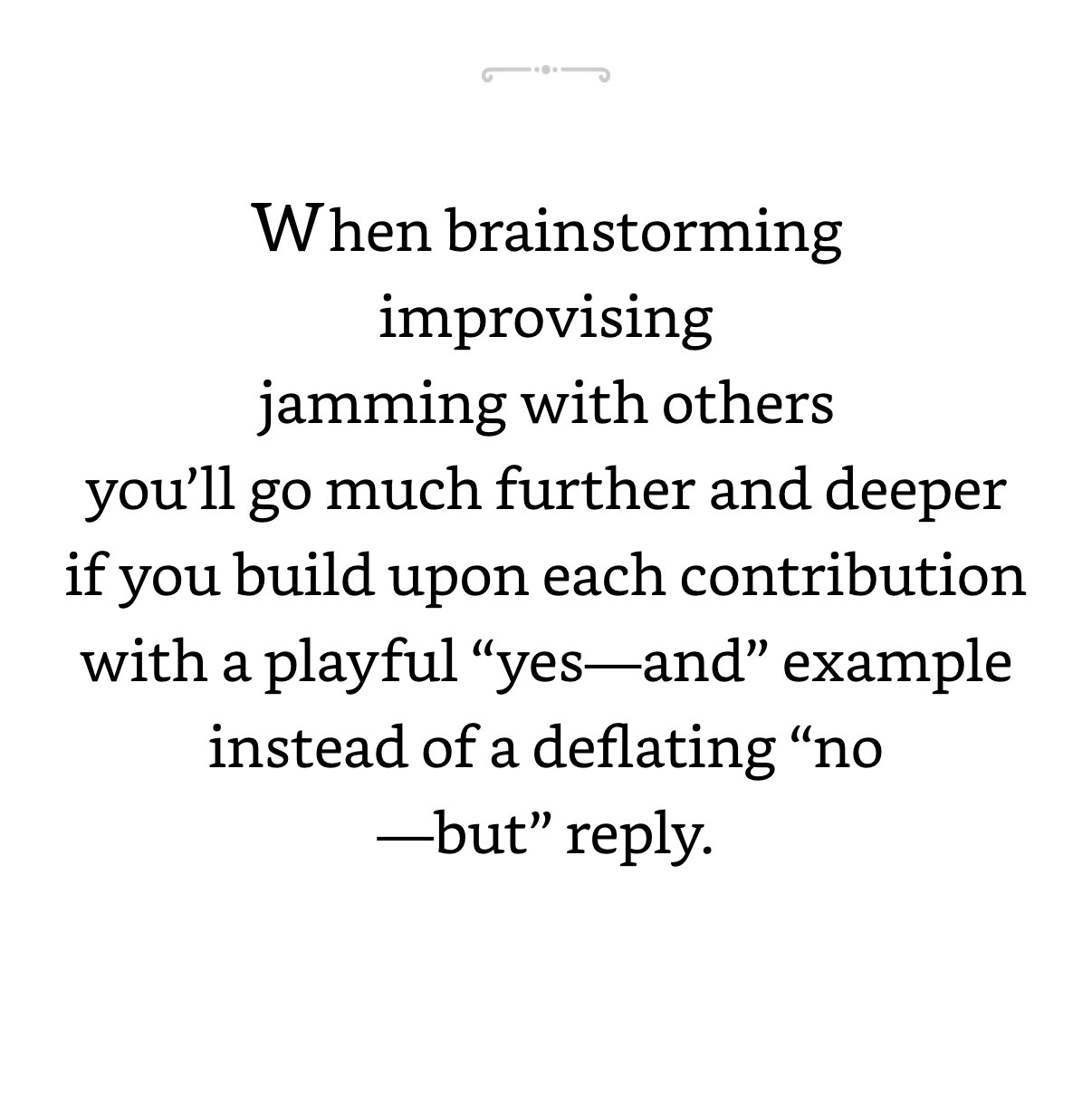
What I love about improv is that you have to “make it up as you go along”. There’s an excitement that comes from not knowing where your partner’s words may take you. You have to respond right away in the moment. There isn’t time for fear to show up or for you to have a perfectly thought-out response that prevents you from moving forward
What if we lived our lives in the same way? In some ways, aren’t we all making it up as we go along? I didn’t know how to be a mother before I was one. Heck, sometimes I am still stumped when my kid asks me something. But I take all the information that is available to me at that moment and come up with the best response possible. Or I say something that will keep them going until the next question-I-don’t-have-a-clue-about comes up. There are moments at work where I’ve felt similarly - especially when working on the “0 to 1” products (the creation of a brand-new, unique product, moving from an idea to a functional Minimum Viable Product) where there isn’t a playbook. I’ve had the most fun when we had to identify product-market fit for a new technology, or determine the best set of partners to help bring a product to market.
“How we live our lives within the structure of our day is an eternal improvisation.”
- Patricia Ryan Madson, Improv Wisdom
I don’t know what comes next in my career or what my dharma is. I’ve been waiting for that clarity for several years. I’ve realized, though, that clarity doesn’t just come knocking on your door one sunny Sunday. Instead you have to take action to move towards it.
For the last couple of months, I’ve been experimenting with the “Yes, and” approach in my life. I want to be open to the opportunities that help me take action and bring me closer to my Ikigai - a Japanese concept meaning “a reason for being” representing the intersection of what you love, what you are good at, what the world needs, and what you can get paid for.
The “Yes”: Be a present mother and wife.
The And: Volunteer in my first grader’s class once a month. Create joyful moments for the kids that become core memories for them.
The “And”: Act as the Neighborhood Social Chair - planning family-friendly events for the community to come together.
The Yes: Manage global partnerships for Shopping at Google.
The And: Volunteer to facilitate workshops across varied topics (navigating difficult partner conversations, growth mindset etc.) at Google because I enjoy helping people expand and grow their skills.
The Yes: Live a joyful creative life. Write for Disco Dialogues.
The And: Take an improv class to practice taking action without overthinking
The And: Have a consistent daily spiritual practice
The And: Cook two new recipes a month for the family
“Yes to everything scary.
Yes to everything that takes me out of my comfort zone.
Yes to everything that feels like it might be crazy.
Yes to everything that feels out of character.
Yes to everything that feels goofy.
Yes to everything.
Everything.
Say yes.
Yes.
Speak. Speak NOW.
“Yes,” I say. “Yes”― Shonda Rhimes, Year of Yes
I am hoping that taking action, however small, will hone my vision for what’s next. At this point without that clarity I’m not able to take the big leap into the unknown. But maybe courage isn’t just about taking the big leap. It’s also the courage to keep moving forward, holding down a steady job, reaching for people that make you feel connected, creating things that make you feel alive, and being of service when you can. Perhaps if I continue to live this way, then one day I will build up the courage to pursue my ikigai.
Until then, all I can do is continue to just show up - ready to play and ready to serve.
Can you remember a time when you stopped doubting yourself and started doing again?
“You just have to keep moving forward. You just have to keep doing something, seizing the next opportunity, staying open to trying something new. It doesn’t have to fit your vision of the perfect job or the perfect life. Perfect is boring, and dreams are not real. Just . . . DO.”
― Shonda Rhimes, Year of Yes
Action/reflection = praxis.